

2.2 Findings and Discussion


Section B : Perceptions of Power & Manipulation
According to the survey, a majority of the people believe that being rich and having status allows individuals to influence others more easily. In the first question, an overwhelming 94.8% said yes and only a few said no or unsure. Thus, people certainly believe that richer or higher individuals may have greater power and influence over others.
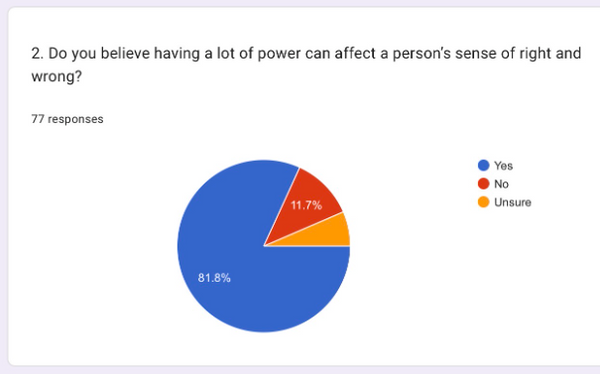
IIn the second question, 81.8% responded that power can corrupt your moral compass, 11.7% responded no and some of them did not know. In essence, many individuals reason that being strong can corrupt your judgment of good and bad and make you justify dubious acts.
The third question was on the best manipulation tricks. It turns out that 72.7% mentioned financial dependency and 70.1% mentioned emotional grooming to be the first on the list. Common ways of people pulling the strings were also indicated with fear (64.9%), social pressure (57.1%), threats (51.9%), and promises of opportunity (51.9%).
The fourth question investigated the reasons as to why victims tend to remain silent when the accused party is a big deal. The findings indicate that fear of retaliation (79.2%) was the most selected reason why individuals gave. Shame or stigma (50.6%), a lack of trust in the authorities (49.4%), and financial dependence (48.1%), were other reasons. The least mentioned was emotional attachment (29.9%). In essence, victims are struggling with a combination of both psychological and social pressure that leaves them unable to speak out.
The fifth question posed whether the manipulation would cause the victims to defend or protect their abuser. The majority (80.5%) answered yes. They can be manipulated to look out to their abuser. A few said no, and 18.2% weren't sure. Therefore, it appears that manipulation does have a potent influence on the behavior and decisions of victims.
Altogether, the results indicate that the power imbalance and psychological manipulation were the major factors that make victims remain silent or even stand in defense of their abusers.
Section C: Institutions & Accountability
The results show that most respondents believe that institutions may sometimes protect powerful individuals. In this question, 37.7% of participants selected “Agree” and 50.6% selected “Strongly Agree.” Meanwhile, 7.8% chose “Neutral,” and only 3.9% disagreed with the statement. These results indicate that a large majority of respondents feel that institutions are not always completely neutral, especially when powerful individuals are involved. This suggests that many people believe influence, wealth, or status may affect how institutions respond to wrongdoing.
For Question 7, respondents showed different perspectives on whether public media exposure increases accountability for powerful individuals. The results show that 46.8% agreed and 19.5% strongly agreed that media exposure can increase accountability. Meanwhile, 20.8% gave a neutral response. On the other hand, 9.1% disagreed and 3.9% strongly disagreed with the statement. Overall, the majority of respondents believe that public media and news coverage can play an important role in holding powerful individuals accountable for their actions.
In Question 8, respondents were asked whether powerful individuals are more likely to avoid consequences for wrongdoing. The results show that 27.3% agreed and 51.9% strongly agreed with this statement. Another 13% selected a neutral response. In contrast, 5.2% disagreed and 2.6% strongly disagreed. These findings show that most respondents believe that people with wealth, authority, or strong social connections may have a higher chance of escaping punishment compared to ordinary individuals.
Finally, Question 9 explored whether people would behave differently if they had extreme wealth and power. The results show that 42.9% agreed and 45.5% strongly agreed that individuals might treat others differently when they possess significant wealth and influence. Meanwhile, 5.2% remained neutral, while 3.9% disagreed and 2.6% strongly disagreed with the statement. This suggests that many respondents believe that power and wealth can influence how individuals behave toward others.
Overall, the findings from this section suggest that many respondents believe that wealth, power, and influence can affect accountability in society. A large number of participants feel that institutions may sometimes favor powerful individuals and that people with strong social or financial influence may find it easier to avoid consequences. At the same time, many respondents also believe that public media exposure can help increase accountability by bringing attention to these issues.
Section D: Awareness of the Jeffrey Epstein Case
Question 10 examines how familiar respondents are with the Jeffrey Epstein case. From the 77 people who answered the survey, the results show that awareness of the case is different among them. The biggest group, 44.2%, said they were somewhat familiar with the case. Meanwhile, 29.9% said they were very familiar, showing that quite a lot of people really know about it. On the other hand, 22.1% said they were only slightly familiar, and 3.9% said they didn’t know about it at all.
These results show that even though the Epstein case got a lot of attention worldwide, not everyone knows it well. But most people at least have some idea about what happened.
When looking at where people got their information, social media was the top source, chosen by 66 respondents. News outlets were next with 31 people, followed by podcasts or documentaries with 27. Some 17 respondents said they heard about it from friends or family.
This shows how important modern media is in spreading information about global issues. Social media, in particular, seems to play a big role in shaping public awareness and discussions, especially among younger people.
Section E: Analysis of Open-Ended Responses
This section looks at answers from open-ended questions about how power can affect moral choices and why manipulation is often more effective when used by powerful people.
For the first question about how power affect moral decisions, many respondents said that having power can make people feel less responsible and more likely to do bad things. A common idea was that rich or powerful people sometimes feel rules don’t apply to them. Some said power can make people feel superior, which might lead them to justify actions that hurt others.
Another common view was that power can make a person’s true personality show more. Some respondents thought that people who are already selfish or manipulative might act worse once they get power. A few said that power doesn’t necessarily corrupt someone, but it shows who they really are.
Many also talked about how powerful people often face fewer consequences. Because they have money, influence, and connections, it’s easier for them to avoid punishment. This can make it easier for them to cross moral boundaries.
For the second question about why manipulation works better when someone is powerful, a few main ideas came up. One was fear. People might feel intimidated by powerful individuals because of their status or authority.
Another reason is money and social influence. Wealthy people can use their money, resources, or connections to control situations, silence others, or influence organizations. Some also said powerful people can shape public opinion using media.
Moreover, trust and credibility were mentioned too. Powerful people are often seen as successful or respected, which can make others trust them more or hesitate to question them.
Overall, the answers suggest that many people think power creates an unfair advantage, making manipulation easier and accountability harder. This shows that authority, wealth, and influence can strongly affect how people make ethical decisions in society.



Philosophical Discussion
ESSAY/ANALYSIS
Throughout history, positions of power and wealth have always been a catalyst for corruption and moral degradation, prompting examination on the relationship between power, authority, ethics and human behaviour. Understanding different philosophical approaches developed across different eras within both east and west helps us understand the core foundations for corruption, alongside the psychological aspects of power. This framework also serves as a bridge for further in-depth analysis on how individuals such as Jeffrey Epstein were able to rise and maintain positions of power and influence despite significant ethical violations. The 2 philosophies that we are to examine originating from the West would be Plato’s Ring of Gyges, alongside The Banality of Evil, coined by Hannah Arendt ; with Confucianism representing philosophies originating from the East.
“Now that those who practise justice do so involuntarily and because they have not the power to be unjust will best appear if we imagine something of this kind: having given both to the just and the unjust power to do what they will, let us watch and see whither desire will lead them; then we shall discover in the very act the just and unjust man to be proceeding along the same road, following their interest, which all natures deem to be their good, and are only diverted into the path of justice by the force of law.” Plato, 2008, p213.
The Republic, Book II mentions a cynical argument regarding human nature, in that people are “just”, only because they have no power to get away with injustice. Glaucon, speaker in this part of the text suggests a philosophical test, giving both a good and bad person complete freedom, without punishment, law and consequences and finally make our observation. He predicts that both people will end up doing selfish things that benefit them. This test represents the birth of the philosophical idea of the Ring of Gyges, in that said ring provides the power to become invisible at will. Using this ring, a shepherd by the name of Gyges abuses this power to seduce the Queen, murders the king and usurp his kingdom. This story highlights the moral question of ‘Without fear of consequence, would they act the same as Gyges?’
To tie this back into our case study, we can see the similarities of power between Gyges and Jeffrey Epstein. Both possessed the power to remain unseen and unpunished, leading to moral degradation and acts of corruption and ethical violations. Whilst one had the mystical power to turn invisible, the other had the power of political influence and wealth, allowing them to remain unseen and untouched by legal and moral consequences. This comparison reflects Plato’s argument that when individuals are free from accountability, they become inclined to act unjustly, raising the philosophical question of whether the possession of power itself births corruption, or from the absence of consequences that corruption is born.
“The sad truth is that most evil is done by people who never made up their minds to be good or evil.” A conclusion derived from her final (and unfinished ) book, ‘The Life of the Mind’, represents the core idea of ‘The Banality of Evil’, about how institutional and psychological complicity gives birth to the greatest of evil. In “Eichmann in Jerusalem: A Report on the Banality of Evil” (1963), Arendt observed the trial of Adolf Eichmann, and his role in the organization of the logistics regarding the transportation of Jews to concentration camps during the Holocaust. Arendt noted that he was never a ‘monster’ in the classic sense, that he was never sadistic or overtly cruel, but that his ‘cruelty’ was due to his ordinariness. Eichmann followed orders blindly, avoided thinking critically and obeyed without morality. His acts were never due to hatred, simply that he never stopped to question them. Arendt dubbed this the “Banality of Evil”, that evil comes from thoughtlessness, not passion.
Institutional and psychological complicity, how ordinary people can commit atrocities without overt malice, how silent obedience enables evil to persist, and how evil grows from failure to reflect and act morally.
Epstein’s case showed a modern echo of the “Banality of Evil”. Many of Epstein's orbit likely knew of the atrocities committed yet stayed silent. Staff, Associates and even his surrounding Elites propagated evil, not through dramatic acts of malice, but their systematic, normalized compliance and silence.
Confucianism is a system of thought founded by Confucius in the Hundred Schools of Thought (500BCE), integrating philosophy, ethics and social governance. Confucius focused on the virtue and responsibility of those in positions of authority, thinking that society best functions when roles are fulfilled ethically. The key aspect of Confucianism that will be analysed however is the failure of embodiment of virtue (ren) by leaders.
Confucius highlighted that failure of Moral Leadership leads to ripples in society: be they loss of trust in institutions, unethical behaviour among subordinates, and even the eventual collapse of society.
“子日其身正, 不令而行; 其身不正, 虽令不从”
Analect 13.6, directly translated as ‘The Master Said, “When the ruler is correct, his will is put into effect without the need for official orders. When the ruler’s person is not correct, he will not be obeyed no matter how many orders he issues”’ This statement, originating from book 13 (Zi Lu) of the “Analects of Confucius” highlights how characters of those in power shape the behaviour and ethical standards of those around them. When leaders fail to embody virtue, their subordinates are likely to follow, leading to a culture of moral decay. In the Epstein Case, the network of abuse surrounding him illustrates this as his ‘Ruler’, legal governance and authority failed to uphold their legal and moral duty, instead participated in the acts of evil propagated by him, breeding grounds of corruption, ethical violations and moral degradation. The lack of moral credibility central to governance led to the exploitation by Epstein, and with the further lack of decisive action due to compromised integrity, the atrocities committed were allowed to continue.
Confucius highlights that Virtue represents a preventative mechanism. Had the proper authorities involved acted with consistent moral integrity, the systematic abuse would have been curtailed much earlier, aligning the Confucian ideal that society functions only when virtuous leaders set a proper tone.
Through the lenses of Western and Eastern philosophy, a common thread emerges: in that corruption influenced by power is universal and multifaceted. Plato’s Ring of Gyges illustrates how freedom from accountability leads to the corruption of an individual be they ‘just’ or ‘unjust’; Arendt’s Banality of Evil demonstrates thoughtless compliance, leading to perpetuated systematic harm; and Confucianism complements these insights by asserting the critical role of ethical leadership and the ripples of moral failure in governance. By combining these philosophies, we see how the case of Epstein arose from an interplay of choice, institutional compliance, and the absence of virtue. This case now serves as a modern testament to these philosophical truths, reminding us of the importance of ethical vigilance, moral reflection and principled leadership.
Through the lenses of Western and Eastern philosophy, a common thread emerges: in that corruption influenced by power is universal and multifaceted. Plato’s Ring of Gyges illustrates how freedom from accountability leads to the corruption of an individual be they ‘just’ or ‘unjust’; Arendt’s Banality of Evil demonstrates thoughtless compliance, leading to perpetuated systematic harm; and Confucianism complements these insights by asserting the critical role of ethical leadership and the ripples of moral failure in governance. By combining these philosophies, we see how the case of Epstein arose from an interplay of choice, institutional compliance, and the absence of virtue. This case now serves as a modern testament to these philosophical truths, reminding us of the importance of ethical vigilance, moral reflection and principled leadership.
Western and Eastern Philosophy
Logic
Analysis of Findings Using Logical Theories
The results of the survey about power, manipulation, institutions, and awareness in the case of Jeffrey Epstein can be interpreted in the light of the philosophical tenets of the study of Logic, which is defined as the science and the art of the right thinking. Logic assists one in differentiating sound arguments and unsuitable arguments based on premises, conclusions, and potential fallacies in an argument.
Inductive Reasoning and Public Perception
The inductive reasoning, or the derivation of general conclusions on the basis of certain observations, is one of the key logical methods that can be observed in the survey results. This kind of reasoning seems to be employed by many respondents with regard to the connection between wealth, power and manipulation.
To explain, in Section B, 94.8% of the respondents feel that being a wealthy and a status individual enables one to manipulate people more conveniently, and 81.8% think that power corrupts the moral compass of a person. The conclusions are probably informed by an observation of real life cases of powerful individuals. Through watching the example of the Epstein scandal, and other cases of elite abuse, the respondents make the generalization that power is frequently used to abuse or manipulate. But, as per the logical reasoning, inductive reasoning gives only probable conclusions and not definite truths, as it is not possible to analyse all the cases of powerful people.
On the same note, the survey established that 79.2 percent of the respondents think victimization makes them keep silence primarily due to the fear of retaliation, and half of them added that it is shame or stigma as well as 49.4 percent responded that it is lack of trust in the authorities. These reactions demonstrate that individuals are coming up with broad inferences basing on what many individuals are consistently reporting in regard to abuse incidences. Although these trends can be backed up by evidence, inductive reasoning brings to mind that these conclusions can only be inductive rather than definitive.
Deductive Reasoning in Understanding Power and Manipulation
The other logical method that can be used to present the findings is the deductive reasoning method, which is the ability to make specific conclusions based on general premises.
The logic of most of the respondents, as an example, may be arranged in a deductive way:
Premise 1: Strong people are rich, famous and influential.
Premise 2: those who are more influential can easily control others.
Conclusion: As such, influential people can control others more readily.
This argument is confirmed by the survey data whose findings revealed that 72.7% perceived financial dependency and 70.1% emotional grooming were good manipulative techniques. The conclusion is a logical conclusion in case the premises are taken to be true. Nonetheless, deductive reasoning presupposes that the premises should also be true. When the premises are not complete or blown out of proportion the conclusion which comes about may not be an accurate portrayal of the reality.
Abductive Reasoning and Explaining the Epstein Case
The findings of the survey can also be interpreted by using the concept of abductive reasoning that presupposes development of the most probable explanation based on the pieces of evidence that are at hand. Abductive reasoning can be employed by the respondents in their attempts to elucidate the reasons why influential people seem to escape punishment in some circumstances.
In Section C, 79.2% of the respondents think that powerful people are more likely to go unpunished and 88.3% of the respondents think that sometimes the institutions may shield the powerful people. Such conclusions can emerge due to the fact that people are witnessing results with rich persons seeming to be sentenced to lesser punishment. Resting on these observations, the respondents conclude that the best possible explanation can be the institutional influence or corruption.
Nonetheless, abductive reasoning is not a certainty of truth, but just a good explanation taking into consideration the existing evidence. These outcomes may also be caused by other factors including legal complexity or absence of evidence.
Heuristic Thinking and Social Media Influence
Section D of the survey also reveals the use of the heuristic reasoning which can be defined as the mental shortcuts that individuals make to make judgments quickly. Based on the findings, the most popular source of information about the Epstein case was the social media, then the news outlets, and lastly the documentaries.
With excessive use of social media, individuals can be influenced to make opinions too fast through simplified accounts or popular views that are shared with everyone. Huristic thinking enables a person to be able to think through complicated information in a short time, however it may also result in simplistic assumptions. This was the reason the awareness of the Epstein case was varied with 44.2 per cent somehow familiar, 29.9 per cent very familiar with others having limited knowledge.
Logical Fallacies in Public Reasoning
The other logical concept that is significant is the concept of logical fallacies which are logical errors in reasoning that undermines arguments. A number of fallacies can potentially affect the interpretation of the power and manipulation problems by individuals.
An example is hasty generalization where certain conclusions are made based on few examples. Cases such as the Epstein case are high-profile ones that might make a person assume that every rich individual is abusing their power or that institutions are always on the side of the rich. Although such conclusions can be affected by the real events, they might not reflect all situations.
The other fallacy that may be possible is appeal to emotion that is achieved when the arguments are based on an emotional feeling instead of a logical evidence. Due to the gravity of the allegations presented in the case of Epstein, the responses of people are frequently motivated by anger, the side with the victim, or the mistrust of the elites. Although it is possible to justify these emotional reactions, logical analysis means that it is necessary to consider evidence but not to conduct logical analysis based on the emotional reactions.
Conclusion
In general, the results of the surveys illustrate the influence that various types of logical thinking have on the perception of power, manipulation and accountability by the population. Inductive reasoning is applicable to most responders as they tend to generalize patterns of powerful people, and deductive reasoning assists in arranging arguments regarding influence and manipulation. The abductive reasoning enables individuals to come up with an explanation as to why influential actors can get away with actions, and the heuristic thinking provides a clarification on how individuals can make fast judgments basing on the information presented by the media. Simultaneously, logical fallacies, including hasty generalization and appeal to emotion, can also affect the way people can interpret social problems that are complicated.
A logical analysis of these findings emphasizes that critical thinking should be applied when making evaluations on cases of powerful people. Through the study of the reasoning mechanism, people can be more self-aware on differentiating sound and unsound arguments when tackling the problems of power, influence, and justice.
Psychology and Sociology Perspective
The results of the survey demonstrate that a high number of respondents think that accountability in society can be influenced by wealth, authority, and social influence. The majority of the participants concurred that institutions can occasionally cover strong persons and most of them concurred that those who have money and power tend to evade the repercussion of misconduct. Moreover, most of the respondents are of the opinion that media exposure is capable of enhancing accountability through paying attention to such problems. These findings do indicate that power has the capacity to mediate ethical conduct and institutional justice.
Psychologically, human behavior is not just determined by reasoning but by emotions and personal desires. Aristotle in western philosophy defined man as a rational creature who could make moral choices. Nonetheless, subsequent views state that emotions and self-interests are also factors that define human behavior. The survey answers confirm this point since a significant number of respondents feel that authority figures can feel superior or feel that rules do not apply to them which will result in unethical actions.Within the frame of sociological perspective, the findings reveal the impact of social structures and power dynamics on society. Inequality may arise when wealth and power are concentrated in some circles and it can be easy to evade accountability by the powerful. Simultaneously, the contribution of the public media demonstrates that social institutions could also contribute to the transparency and fairness.These results may be connected to the model of Insan Sejahtera that underlines the balance of the physical, emotional, spiritual, and intellectual levels (JERI). A balanced person needs to be responsible in his use of power and be empathetic and morally conscious. Thus, to have a sejahtera society, we must have ethical leaders, fair institutions and moral actors who will not lose their moral compass even when they have power or influence.
Philosophy of Sejahtera Analysis
Based on the results of the survey, the majority of the respondents have the perception that wealth, power, and social status have the ability to manipulate a person’s behavior. The data shows that 94.8% of respondents agreed that people who are rich or have higher status can influence others more easily. Meanwhile, 81.8% of respondents also believe that power can affect a person’s sense of right and wrong. Besides that, many respondents mentioned many manipulation tactics that are often used by powerful individuals. Some of the common ones are financial dependency, emotional grooming, and fear. These results show that when there is a big difference in power in society, some individuals may misuse their authority to control or manipulate others.
From the perspective of the Philosophy of Sejahtera, this kind of behaviour shows that balance and harmony in human life are not achieved. The concept of Sejahtera refers to a state of well-being that includes peace, safety, prosperity, and also moral balance. It focuses not only on external success but also on inner values and ethics. Based on this philosophy, people should live in a balanced way by combining intellectual, emotional, spiritual, and moral values. When power is used only for personal benefit, it disturbs this balance and can cause harm to society.
The survey also showed that 79.2% of respondents think that victims usually remain silent because they are afraid of retaliation. Some respondents also mentioned other reasons such as social stigma, lack of trust in the authorities, and financial dependence on the person with power. This situation shows that when power imbalance exists, it becomes harder for victims to get justice. From the Sejahtera perspective, justice and fairness are very important because they help maintain harmony in society. Therefore, people who hold authority should act responsibly and ethically since their decisions and actions can affect the well-being of others.
The ideas of philosophers such as Plato also support this view. Plato believed that people who lead or govern society should understand justice and moral values. In a similar way, Ibnu Sina explained that true happiness can be achieved when people live according to moral values, religious teachings, and a system that promotes justice. These ideas are related to the concept of Sejahtera, which encourages individuals to act with responsibility and respect towards others.
In addition, the Philosophy of Sejahtera also emphasizes the importance of building balanced individuals who can contribute positively to society. This idea is also connected to the National Education Philosophy and the principles of Rukun Negara, which aim to develop citizens who are balanced in intellectual, emotional, spiritual, and physical aspects. When people focus only on personal gain and ignore ethical responsibility, it can weaken trust in society and disturb social harmony.
Overall, the survey results show that many people are aware that power imbalance can be dangerous, especially when it is used by people who have wealth or authority. From the Sejahtera perspective, it is important for both individuals and institutions to practice justice, ethical leadership, and social responsibility. When these values are applied, society can become more balanced and harmonious, and power will be used in a more responsible way that protects the well-being of others.
Ideology (Modernism, Postmodernism and Relativism)
The survey results show that many respondents think wealth and power give people more influence and might let them escape punishment for doing wrong. For example, 94.8% agreed that people with money and status can influence others more easily, and most also felt that power can affect a person’s moral judgment. These answers highlight an important issue connected to ideology, especially ideas in modernism, postmodernism, and relativism.
From a modernism perspective, society should run on rational systems, laws, and institutions that make things fair and hold people accountable. The lecturer’s notes say that modernism focuses on reason, science, and human ability to build a better, fairer society. But the survey results show that many people feel these systems don’t always work as they should. The high number of respondents who think powerful people can influence institutions or escape punishment suggests that the fairness modernism promises isn’t always seen in real life.
This situation also connects to postmodernism. Postmodernism came up as a response to the failure of modern systems, which were supposed to bring progress and equality. According to the lecturer’s notes, postmodernism often questions authority, rational systems, and whether institutions can be trusted. In the survey, many respondents felt that institutions sometimes protect powerful people, and that extreme wealth and power can change how people are treated. These opinions show a skeptical view of social institutions, which is a key feature of postmodern thinking.
Another idea linked to the findings is relativism. Relativism says that truth and moral values can be subjective and depend on a person’s perspective. Some survey responses show that people think powerful individuals may justify unethical actions because they feel rules don’t apply to them. This shows how moral standards can become flexible when power and influence are involved. But, as the lecturer’s notes explain, relativism can also create contradictions, because if all values are relative, it’s hard to set clear moral rules or enforce justice.
Overall, the survey results show that even though modern society tries to promote fairness through rational systems and institutions, wealth and power can make it harder to achieve this. The responses show a growing skepticism toward institutions, which fits with postmodern ideas, and they also raise concerns about moral relativism when power and influence affect ethical choices.